
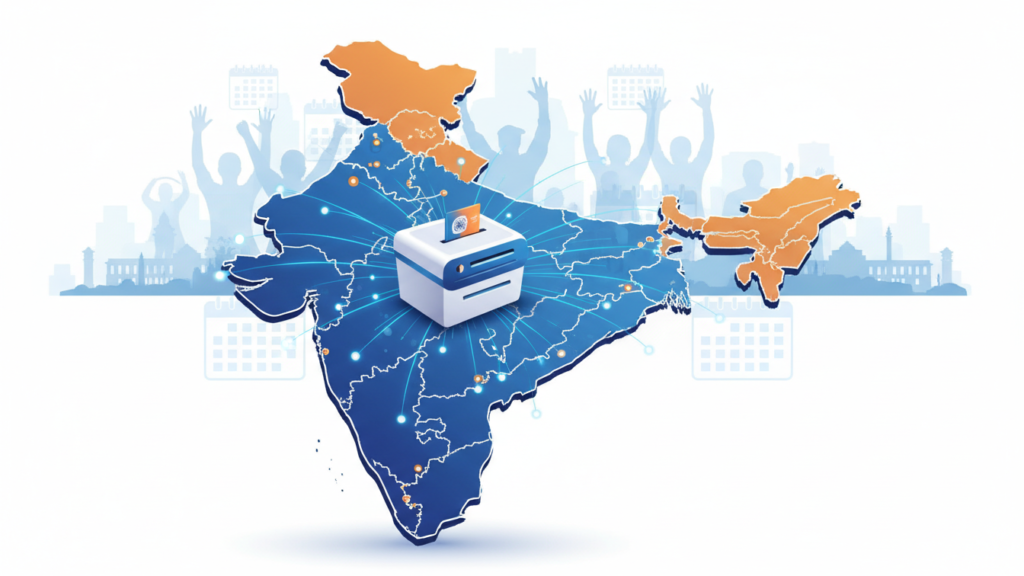
One Nation One Election : For India’s Democracy
India is the World’s largest democracy. India conducts elections on an unparalleled scale. With Lok Sabha Election on every five years and also various state assembly elections scattered across different months, the country enters a continuous electoral cycle. This leads to frequent use of public resources, recurring implementation of the Model Code of Conduct (MCC), and ongoing political disruptions.
To reduce this cycle and improve governance efficiency, the idea of “One Nation One Election” (ONOE) has gained national attention. The concept proposes simultaneous elections for the Lok Sabha and all State Legislative Assemblies. But what would this mean for India’s democracy?
What is One Nation One Election
One Nation, One Election, is a proposal under consideration by the Government of India to synchronise all elections in the country either on a single day or within a specific time frame, with an objective of cutting election cost. One of its most notable proposals is to simultaneously conduct elections to the Lok Sabha & state legislative assemblies of all twenty-eight states and eight union territories.
The goal is to synchronize the electoral calendar so that India votes only once every five years, instead of multiple times throughout the year.
READ MORE : India A Rising Superpower: Global Expectations For 2025-2030
Why is This Idea Being Discussed Now?
This idea is not new. India actually held simultaneous election in 1952, 1957, 1962 and 1967. Howevery, due to political instability, early dissolution of assemblies, and shifting conditions, the cycle broke after 1967.
In recent years, the Government of India and various committiees have revisited the idea because:
- Election occur almost every few months
- Huge financial and administrative resources are used repetedly
- Development projects slow down during MCC
- Law and order force are constantly mobilized for election duty
This makes ONOE a proposal with significant potential impact.
Benefits of One Nation One Election
- Reduced Election Expenditure
Conducting election costs thousands of crores. Simultaneous election can save public money, reduce campaign cost and optimize resources like EVMs, and VVPATs. - Model Code of Conduct Restriction
The MCC slow down government works as new schemes and approvals can not be announced. If elections happen only once in 5 years, policy-making become smoother. - Governce and Administrative Efficiency
Bureaucracy often gets diverted from routine work to election duties. ONOE would allow focused governance without recurring disruptions. - Reduced Political Polarization
Frequent elections intensify political competition and campaigns. Simultaneous elections may reduce continuous political rhetoric and allow more issue-based governance. - Increased Voter Participation
Instead of visiting polling stations multiple times a year, Indians would vote once, potentially leading to higher voter turnout.
Challenges and Concerned
While the benefits are substantial, One Nation One Election faces several challenges that must be addressed:
- Constitutional Amendments
To align terms of Lok Sabha and state assemblies, the Constituttion will require major amendments, including changes to Article 83, 85, 172, 174 and 356. - Federal Structure Concerns
State fear that simultaneous election may reduce autonomy, as national issues could overshadow regional priorities. - If Government Falls Early?
Imposing Presiden’s rule or temporary governments to maintain alignment could raise democratic concerns. A clear mechanism would be needed. - Logistic and Security Management
Conducting elections for 900+ million voters at once require huge manpower, polling infrastructure and security forces. - Political Consensus
ONOE can succed only if all political parties agree, making consensus-building crucial.
Would One Nation One Election Strengthen Indian Democracy?
Supporters argue that ONOE could bring:
- Political stability
- Cost-effective elections
- Efficient governance
- Reduced policy paralysis
Critics worry about:
- Weakening federalism
- Overshadowing regional issues
- Risk of centralization
Ultimately, the proposal’s impact will depend on how well the system is designed and whether constitutional safeguards are preserved.
What Reforms Are Required to Implement ONOE?
To make ONOE a reality, India would need:
- Constitutional amendments
- Legal changes in the Representation of the People Act
- A stable mechanism for hung assemblies
- Adequate EVM/VVPAT availability
- A robust central–state agreement
The government may also need a transitional plan to synchronize terms gradually.
Conclusion
One Nation One Election represents one of the most ambitious electoral reforms in India’s democratic history. It promises reduced costs, smoother governance, and fewer political disruptions. However, it also raises important questions about federalism, political balance, and administrative feasibility.
India must carefully weigh the benefits and complexities before adopting such a transformative change. A well-designed, consensus-driven approach could make ONOE a milestone in India’s democratic evolution.
For More Knowledgeable Articles Like This Visit uslearning.in
Pingback: 7 Shocking Truths Connecting Stranger Things to The Montauk Project - uslearning.in