
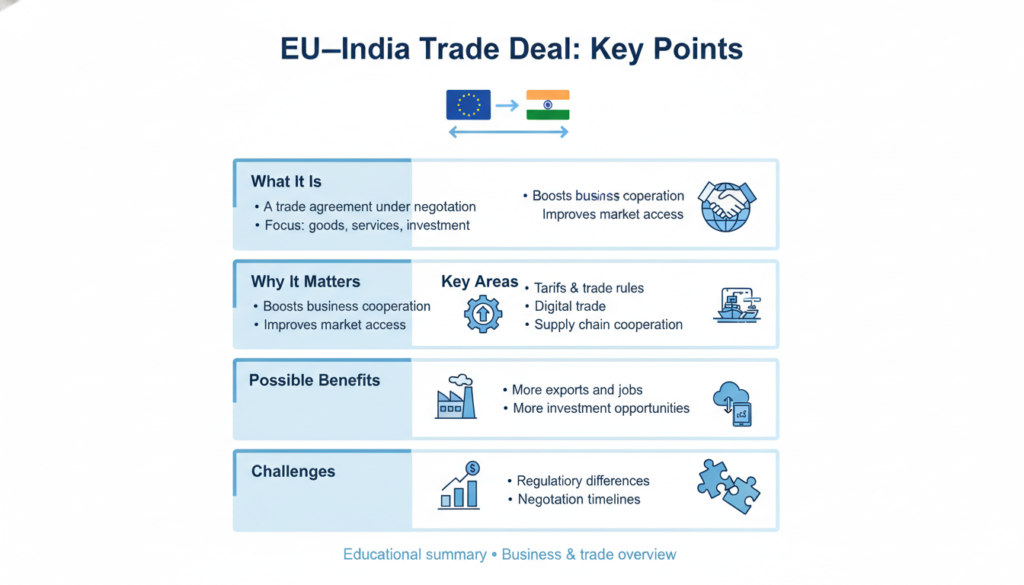
EU–India Trade Deal & Shifting Global Trade Alliances
EU India Trade Deal The global trade map is changing fast, and one of the most important developments is the renewed momentum behind the EU India Trade Deal. As major economies adjust to rising geopolitical tensions, supply chain disruptions, and new economic blocs, the European Union and India are positioning themselves as strategic partners. This potential agreement is not just about tariffs or exports—it signals a major shift in how global trade alliances may look in the coming years.
In simple terms, the EU India trade deal could become a cornerstone of a new era where trade partnerships are shaped more by strategy and stability than by geography alone.
Why the EU India Trade Deal Matters
India is one of the world’s fastest-growing major economies, while the EU remains one of the largest trading blocs. Together, they represent a massive consumer base, strong industrial capacity, and rising influence in global economic governance. EU–India Trade Deal
A comprehensive trade deal between the EU and India aims to reduce trade barriers, strengthen investment flows, and create predictable rules for business cooperation. But beyond the economics, the deal has geopolitical significance—especially in a world where countries are seeking alternatives to overdependence on a single market or supplier.
READ MORE : 7 Critical Geopolitical Risks in 2026 That Will Reshape the Global Power Order
EU India Trade Deal : Key Drivers Behind the Renewed Push
Several global trends are accelerating EU–India trade negotiations:
- Supply Chain Diversification
After the pandemic and ongoing global conflicts, countries are prioritizing resilient supply chains. India offers the EU a strong alternative manufacturing and services hub, especially for pharmaceuticals, technology, and industrial goods.
- Reducing Dependence on China
Many Western economies are pursuing “China+1” strategies—keeping trade with China but reducing dependency. India is a key destination for this shift due to its market size, democratic institutions, and expanding manufacturing ecosystem.
- Rising Geopolitical Competition
Trade deals today are not only about commerce—they’re about influence. As the US, China, and Russia compete for strategic space, the EU and India are looking to strengthen their positions through deeper cooperation.
What Could the Deal Include?
While negotiations are complex, the EU India trade agreement may cover:
- Tariff reductions on goods like automobiles, machinery, and chemicals
- Increased access to India’s market for EU services and investments
- Stronger protection for intellectual property rights
- Rules around digital trade, data, and e-commerce
- Sustainability and labor standards aligned with EU regulations
If finalized, the deal could become one of the largest trade partnerships in the world.
How It Impacts Global Trade Alliances
The EU India deal reflects a bigger trend: the fragmentation and realignment of global trade alliances. The world is slowly moving away from one unified global trade system into multiple overlapping networks.
A Shift from Globalization to “Friendshoring”
Instead of sourcing from the cheapest location, many nations now prefer sourcing from politically aligned partners. This strategy—called friendshoring—is changing investment and trade routes worldwide.
India’s Growing Role in Multipolar Trade
India is increasingly balancing relations with the West, Russia, and regional partners. By strengthening ties with the EU, India signals that it is ready to play a central role in shaping global trade norms while keeping its strategic independence.
The EU’s Search for New Economic Partners
Europe is facing energy challenges, industrial competition, and security concerns. Stronger trade with India can support Europe’s long-term goal of maintaining competitiveness and reducing vulnerability to external shocks.
Who Benefits Most?
If structured well, the agreement could benefit both sides:
- India could gain better access to European markets, increased foreign investment, and improved export competitiveness.
- The EU could benefit from India’s growing consumer market, skilled workforce, and technology-driven sectors.
For businesses, this could mean new export opportunities, cheaper imports, and smoother cross-border operations.
Challenges and Roadblocks
Despite the promise, several issues remain:
- India’s concern about opening sensitive sectors like agriculture and dairy
- EU’s strict environmental and sustainability requirements
- Disagreements over data rules, intellectual property, and market access
However, the strategic value of the partnership may push both sides toward compromise.
Final Thoughts
The EU India Trade Deal is not just another economic agreement—it is a signal of shifting global priorities. As trade becomes more strategic and alliances become more selective, partnerships like EU–India could define the next decade of global commerce.
In a world moving toward multipolar influence, this deal could help reshape trade flows, strengthen economic resilience, and create a new balance in global trade alliances.EU and India trade deal