
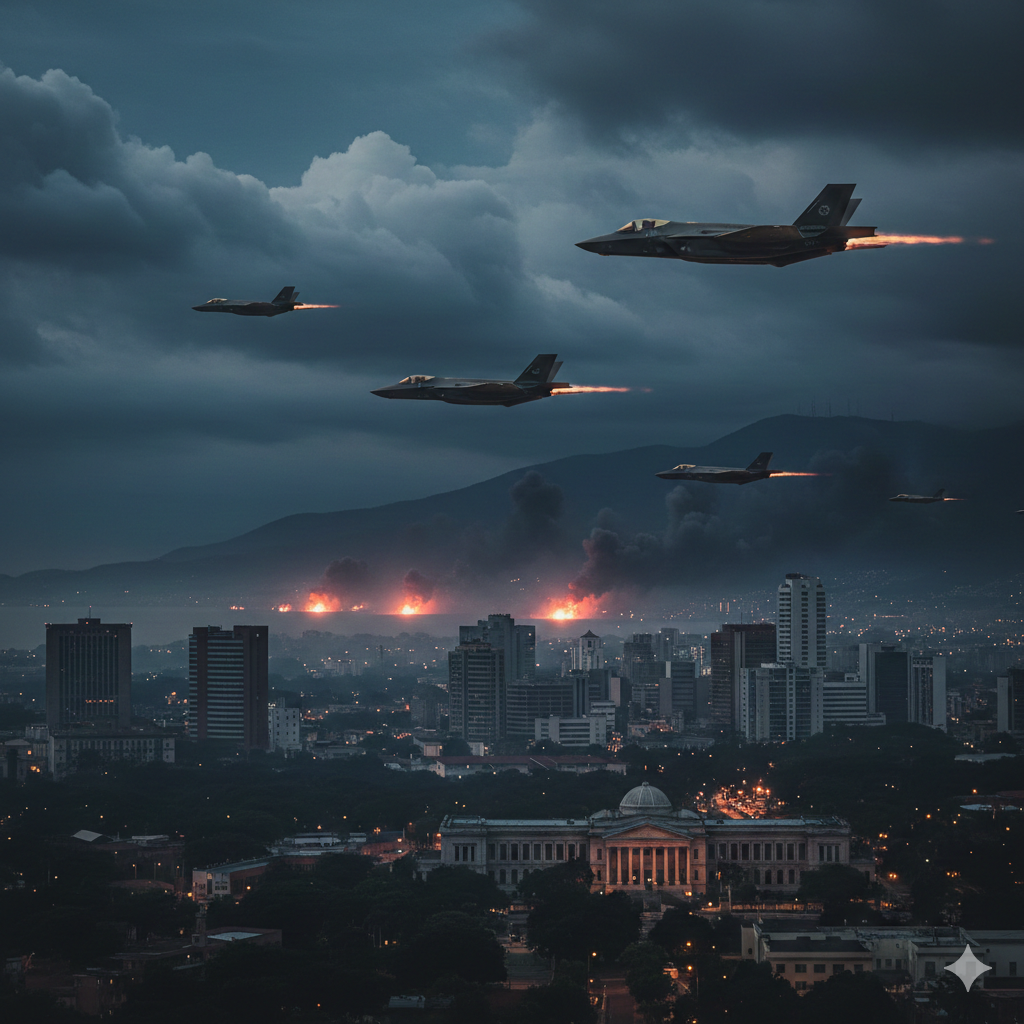
7 Critical Reasons Behind the 2026 US Strike in Venezuela – A Deep Dive
On January 3, 2026 the United States launched a large-scale military strike on Venezuela, seizing Venezuelan President Nicolás Maduro and his wife, Cilia Flores in a dramatic and controvertial operation that has shocked the world. This intervantatiion, reportedly part of Operation Absolute Resolve, marked one of the most direct U.S. Military actions in Latin America in decades. (US Strike in Venezuela)
This article explores why the United States took such drastic step, the global reaction, what it means for international stability, and the big question on everyone’s mind – is this the beginning of World War – III
The Operation: How It Happened
The U.S. military carried out a coordinated strike across multiple Venezuelan location, including Caracas. According to official report:
- The mission began around 2:00 AM local time with explosions and serial bombardments in northern Venezuela.
- Elite U.S. Forces – including Delta Force and other special operation unites – executed the capture of Maduro and his wife.
- They were subsequently flown to New York to face drug-trafficking and narco-terrorism charges.
While U.S. officials called the mission a “law enforcement and security operation,” cities argue it was a military intervention with serious geopolitics consequences.
Official U.S. Justification
The Trump administration and U.S. government spokespeople offered several reasons for the strike: (US Strike in Venezuela)
- Narco Terrorism Claim: The U.S. accused Maduro of running a “narco-state” closely connected with powerful criminal networks like the Cartel de los Soles.
- Security Threats: Officials also claimed Venezuela’s instability contributed to drug trafficking and regional migration pressures.
- Failed Diplomacy: After years of sanctions and diplomatic efforts, Washington suggested it had “no choice” but to escalate to military action.
Economic and Strategic Motives: Oil, Resources, and Geopolitics
Beyond the official rhetoric, analysts and commentators point to deeper strategic motivations:
- Venezuela has the largest proven oil reserves in the world. Control or influence over these resources could shift global energy balances.
- Some experts argue that longstanding U.S. interest in Venezuelan oil, combined with Caracas’ ties to nations like China, Russia, and Iran, made the situation a strategic priority.
- Critics suggest that a transition to a U.S.–aligned leadership could open the door for American energy companies. (US Strike in Venezuela)
Global Reaction — Divided and Heated
The U.S. military action has sparked dramatic global responses:
Opposition & Condemnation:
- China strongly condemned the strikes as a violation of international law and Venezuelan sovereignty.
- Russia, Iran, Cuba, and several Latin American countries labeled the attack “illegal aggression.”
- These nations also warned that such unilateral military force undermines the UN Charter and global norms.
Support or Cautious Views:
- Some nations expressed support or urged peaceful resolution while agreeing that Maduro’s government was problematic.
- Other governments called for dialogue and de-escalation, emphasizing respect for international law.
This global split reflects deeper geopolitical fault lines: U.S. influence versus a coalition of states wary of American unilateral action. (US Strike in Venezuela)
Legal and International Law Questions
Legal scholars and critics assert that the U.S. operation likely breached key international laws, including the UN Charter’s prohibition on the use of force without Security Council authorization. Some argue this sets a precedent that could erode established international norms against unilateral military interventions.
This debate is more than academic — if powerful states can act without restraint, it could destabilize global legal norms.
Is This the Start of World War III?
This is the question many readers, analysts, and commentators are asking.
Arguments Suggesting Escalation
- Some observers fear that a superpower intervening militarily in a sovereign state without United Nations approval signals a new era of power politics over legal frameworks.
- There are concerns that such actions could embolden other nations to act similarly, potentially triggering broader conflicts. Critics ask: if the U.S. can strike a nation unilaterally, why can’t other powers?
Arguments Against an Immediate Global War
- Despite tensions, many experts argue that so far the strike has not triggered formal military responses from other nuclear powers like China or Russia.
- Reactions have been political and diplomatic, not military — suggesting restrained escalation for now.
In short, while the strike is historically significant and dangerous, it does not on its own equate to World War III — at least not yet.
READ MORE : 7 Powerful Facts About Chillai Kalan: Kashmir’s Coldest and Most Extreme Winter Phase (US Strike in Venezuela)
READ MORE : 10 Powerful AI Tools for Students & Teachers in 2026 (Ultimate Guide)
What Happens Next? Uncertain and Volatile
The situation in Venezuela remains unstable:
- The political vacuum raises questions about governance and internal conflict.
- International diplomacy will test whether global institutions can mitigate escalation.
- The precedent of direct intervention will shape future foreign policy debates.
Conclusion
The 2026 U.S. military strikes in Venezuela represent a turning point in international relations. Powered by a combination of political, security, and resource interests, the intervention has sparked controversy and anger worldwide. While it has not yet triggered a global war, its implications for international law, global stability, and great-power politics are profound.US Strike in Venezuela
This historic event — fraught with risk and complexity — will influence geopolitics for years to come. (US Strike in Venezuela)